NASA
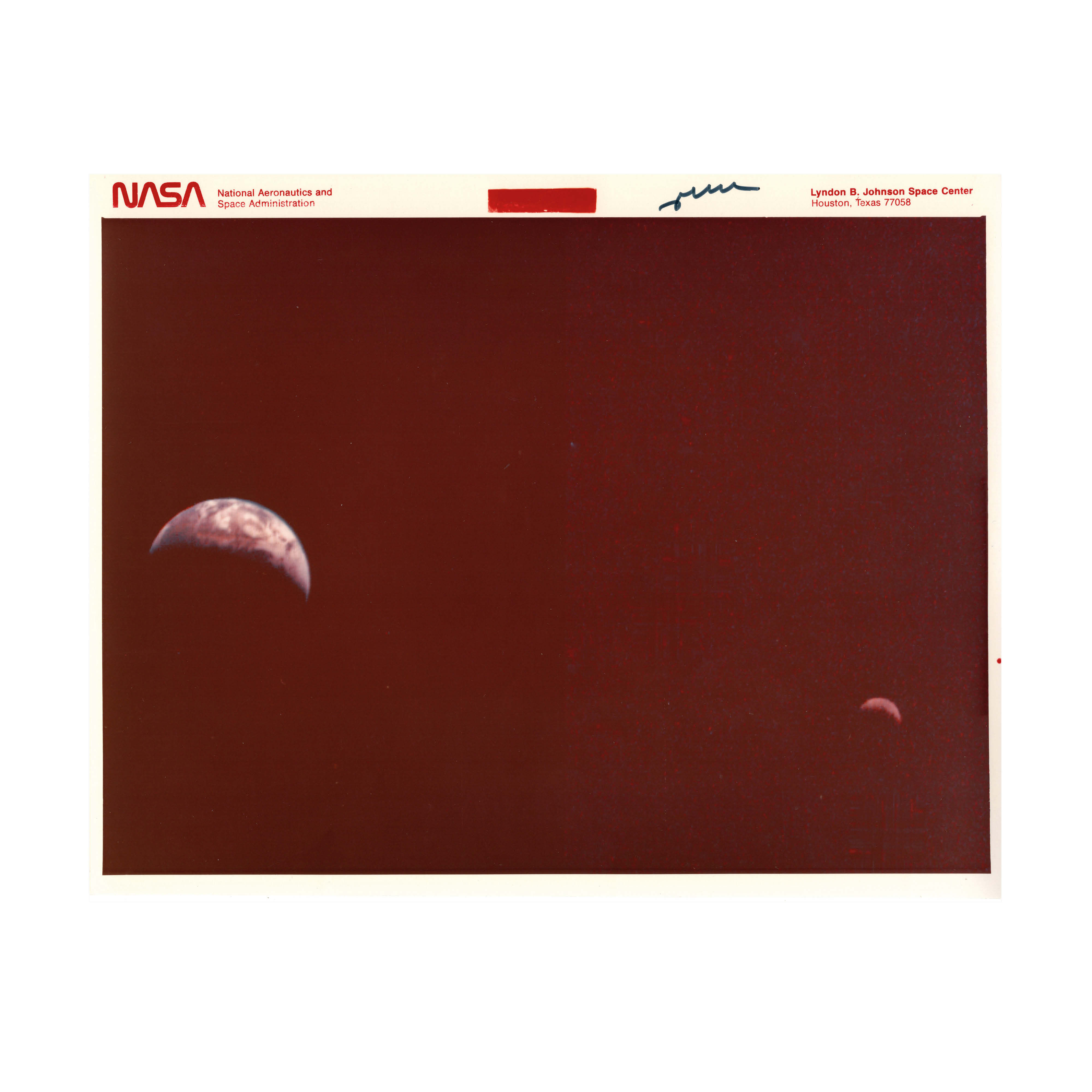
Planet Earth and Her Moon
평가하다
USD $10,000 - 15,000
종료
Jul 1, 2:18pm UTC
NASA
Planet Earth and Her Moon from Jet Propulsion Laboratory, Voyager 1, 18 September 1977
watermarked 'This Paper Manufactured by Kodak'; minor annotation and colour block '[P-19891]' (upper margin)
chromogenic print
7 x 9 1/4 inches (17.8 x 23.5 cm)
Executed in 1977.
Voyager 1 launched from Cape Canaveral on 5 September 1977 aboard a Titan-Centaur rocket. Just days later, from 7.25 million miles (11.66 million km) away—positioned above the night side of Earth, directly over Mount Everest—it captured this image.
Voyager 1 and its twin, Voyager 2, were designed to take advantage of a rare planetary alignment occurring only once every 175 years, allowing gravity-assisted flybys of the outer planets with minimal fuel. This “grand tour” transformed planetary science.
Voyager 1 reached Jupiter in 1979 and Saturn in 1980, while Voyager 2 continued onward to Uranus in 1986 and Neptune in 1989—together completing humanity’s first exploration of all four giant outer planets, their moons, rings, and magnetic fields.
Today, both spacecraft continue their journeys into interstellar space. Voyager 1 entered interstellar space in 2012 and remains the most distant human-made object ever created—still communicating with Earth nearly five decades after launch.
As NASA has noted, even had the mission ended after Jupiter and Saturn, it would have rewritten astronomy textbooks. Instead, the Voyagers transformed our understanding of the Solar System—and continue to do so.