Still Here Spotlight
Meteorites
Meteorites have long fascinated humanity: miniature worlds flung across the solar system. Here we take a deep dive into a collection of three meteorites, two from Mars, one from the Moon, alongside exquisitely rendered microscapes showing their extraordinary composition. Neil Buckland's Cosmic Microscapes bridge art and science and have been featured in galleries and museums around the country, international scientific conferences, and published in WIRED magazine, The Meteorite Times, and peer reviewed scientific papers.
Lunar Meteorite Rabt Sbayta 007
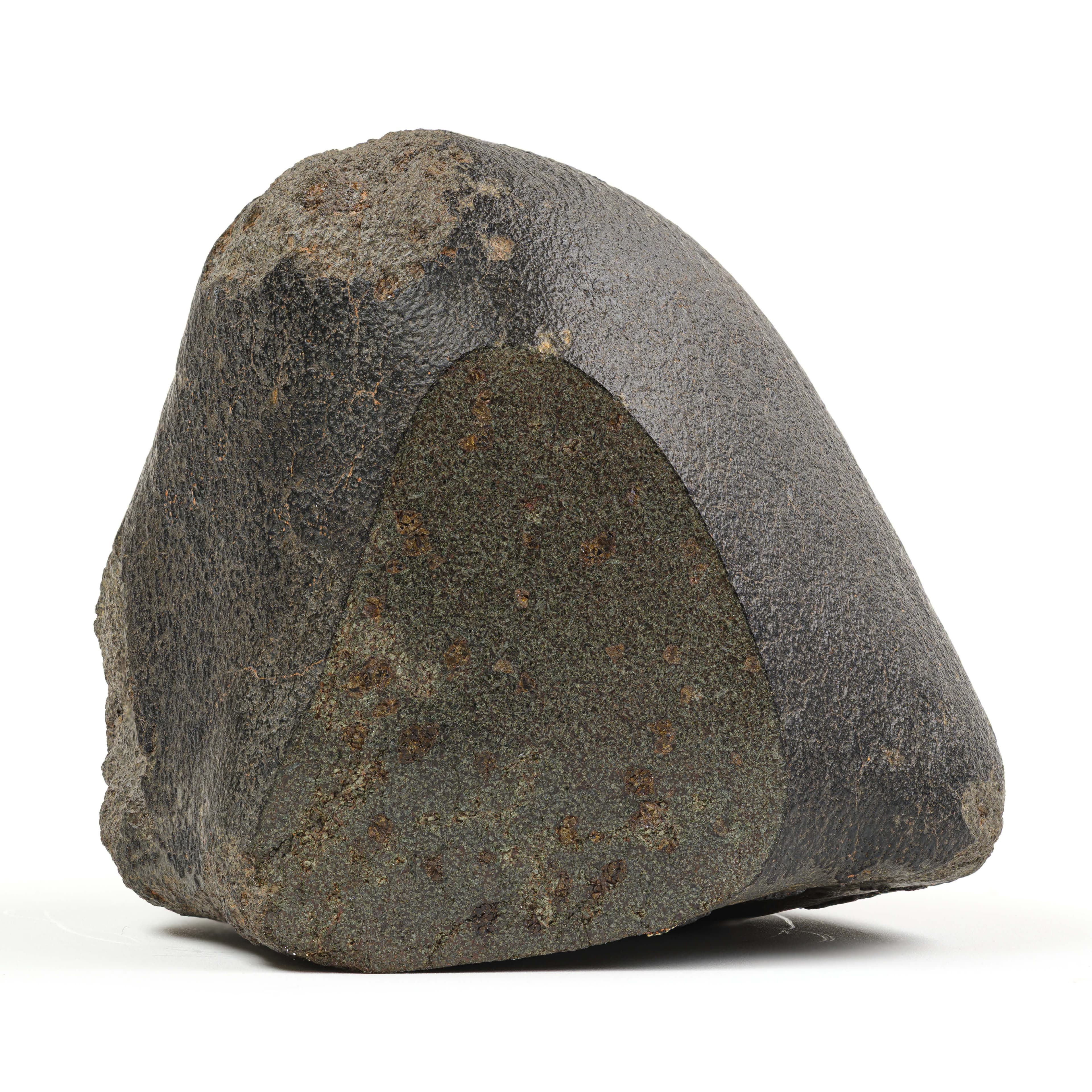
Rabt Sbayta 007 is a piece of the Moon. Found in southern Morocco in 2017, it originated in the feldspar-rich highlands of the lunar surface — the ancient, cratered terrain that covers much of the far side of the Moon and the majority of its southern hemisphere. The original stone weighed 4.430 kilograms; slices were removed for scientific study and separate sale, leaving the present main mass of 1.917 kilograms, with one beautifully polished cut surface revealing the specimen's internal geology.

Rabt Sbayta 007 by Neil Buckland
Working from a single thin section cut to approximately 30 microns, Buckland uses a custom-built micro-panoramic imaging microscope of his own design to capture hundreds of individual photographs, assembling them into a seamless photomosaic. At this thickness, transmitted light passes through the mineral grains of the lunar highland breccia, illuminating the mosaic of fragments cemented together over 4 billion years of bombardment on the Moon's surface: shattered feldspar, recrystallized mineral clasts, glass-welded matrix. At this scale, the geological history of the early Solar System becomes visible as color, geometry, and light.
Martian Meteorite Northwest Africa 13368
Northwest Africa 13368 belongs to the nakhlites — a family of eighteen Martian meteorites that share a common origin in a single volcanic eruption on the surface of Mars. They take their name from Nakhla in Egypt, where a witnessed fall of such specimens occurred in 1911. Age dating studies have established that the nakhlites crystallized from Martian magma 1.3 billion years ago and were ejected from the planet as a group approximately 10 million years ago, following an asteroid impact with sufficient force to overcome Martian gravity.

Northwest Africa 13368 by Neil Buckland
Cut and ground to approximately 30 microns, the threshold at which transmitted light reveals the internal crystal structure of the stone in full colour and detail — Buckland uses a custom-built micro-panoramic imaging microscope of his own design to capture hundreds of individual photographs, assembling them into a seamless photomosaic. At this scale, the mineral grains of a Martian rock become luminous geometries: the individual crystals of the nakhlite, the composition of its matrix, and the aqueous alteration products that record the presence of water on Mars, all made visible for the first time.
Martian Meteorite Boudenib 004
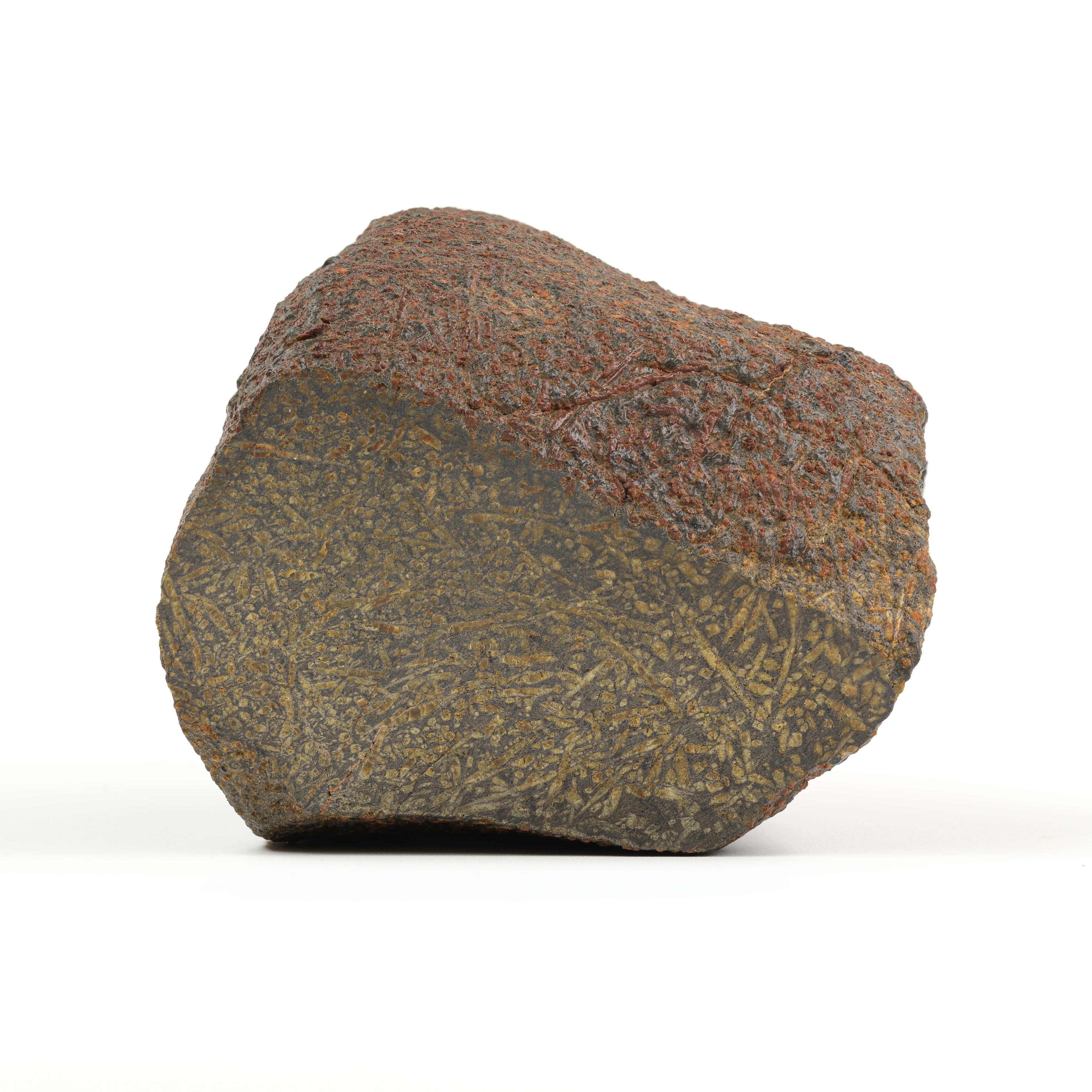
Shergottites are the most abundant family of Martian meteorites, named after the town of Shergotty in India where the first witnessed fall of such a stone occurred in 1865. Boudenib 004, however, is within that family singular. Found in eastern Morocco in 2024, this 660-gram stone is distinguished by an unusual crystalline structure: unusually elongate bladed crystals of pyroxene running through the specimen's interior. This texture has not been documented in any other known Martian meteorite, making this specimen morphologically unique among all recovered Martian material.

Boudenib 004 by Neil Buckland
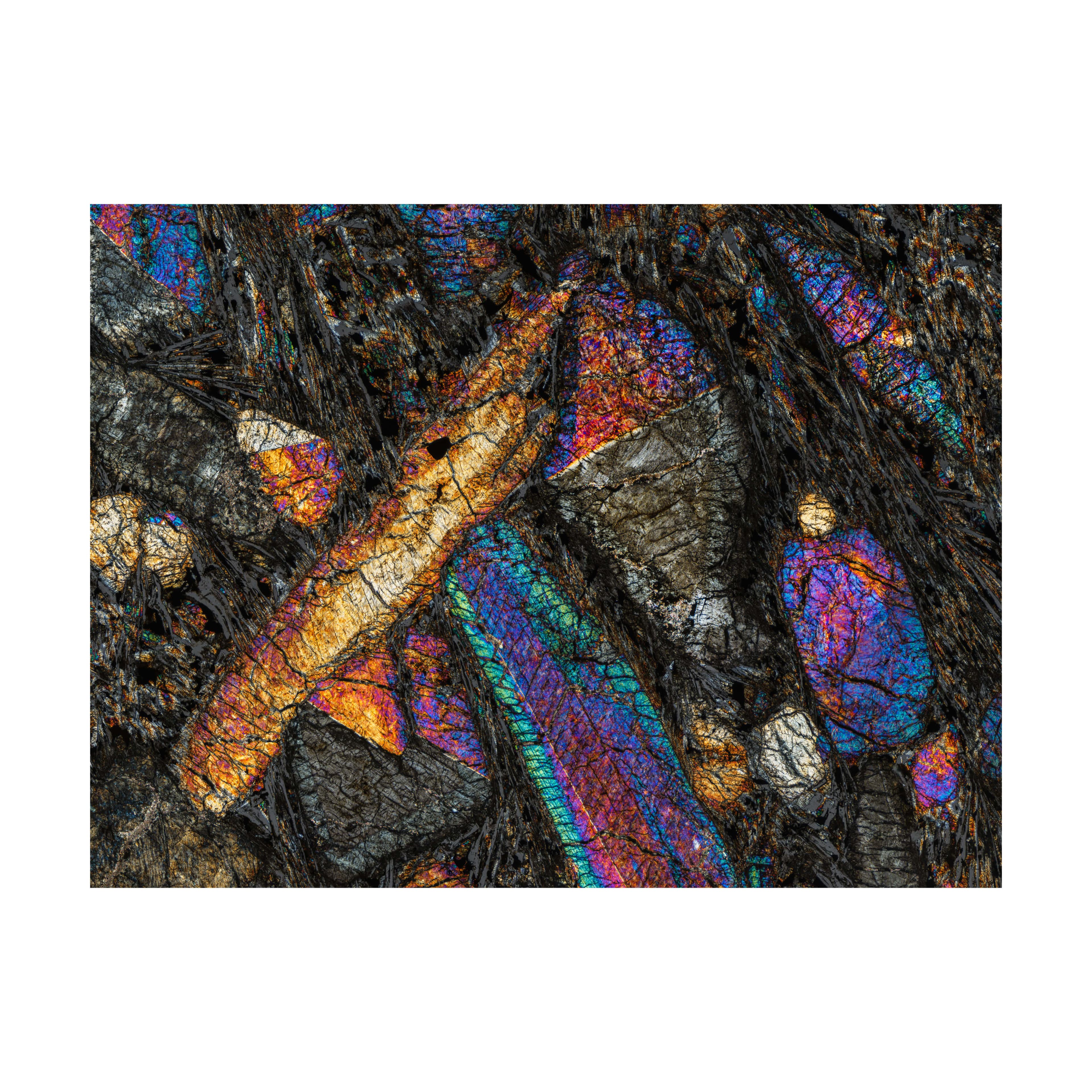
This print is made to order by Neil Buckland from a thin-section microphotograph of the Boudenib 004 Martian shergottite (see Lot 23). The stone's defining feature — its unusually elongate bladed pyroxene crystals, found in no other known Martian meteorite — becomes fully visible only at this scale.