The Only Long-Term Museum-Exhibited Triceratops Skeleton
Ever to Come to Auction
Encountered by more than one million visitors across three decades of public exhibition.
For 66 million years, Trey waited.
Then the world came to see him.
A Life in the Last Age of the Dinosaurs
In the final moments of the Cretaceous world, a young Triceratops moved through the floodplains of present-day Wyoming, in the western United States. The climate was humid and restless. Rivers cut through coastal lowlands. Herds of horned herbivores travelled the valleys in slow, deliberate motion—while, somewhere beyond the tree line, Tyrannosaurus rex held the balance of fear.
It was a world on the brink of extinction—though none of its inhabitants could have known it. Among them was Trey.
From Discovery to Legend
Horns forward. Frill flared. A face built like a fortress. Trey doesn't need an introduction—he's the dinosaur you recognize in a heartbeat. There are dinosaurs, and then there is Triceratops: the silhouette of prehistory. Trey is a cultural monument in the fossil record—museum-exhibited, extensively documented, and offered with a public life few specimens can claim.
Named by O.C. Marsh in 1889 and anchored by the holotype YPM 1820 illustrated in 1896, Triceratops has been central to paleontology since the beginning—one of the key reference genera used to reconstruct Maastrichtian ecosystems. Trey enters that story at its most dramatic moment: the Lance Formation at the close of the Cretaceous Era.


Born Among Giants
The American West 66 million years ago was built for titans. This was the age of the great herds—and the apex predators that followed them.
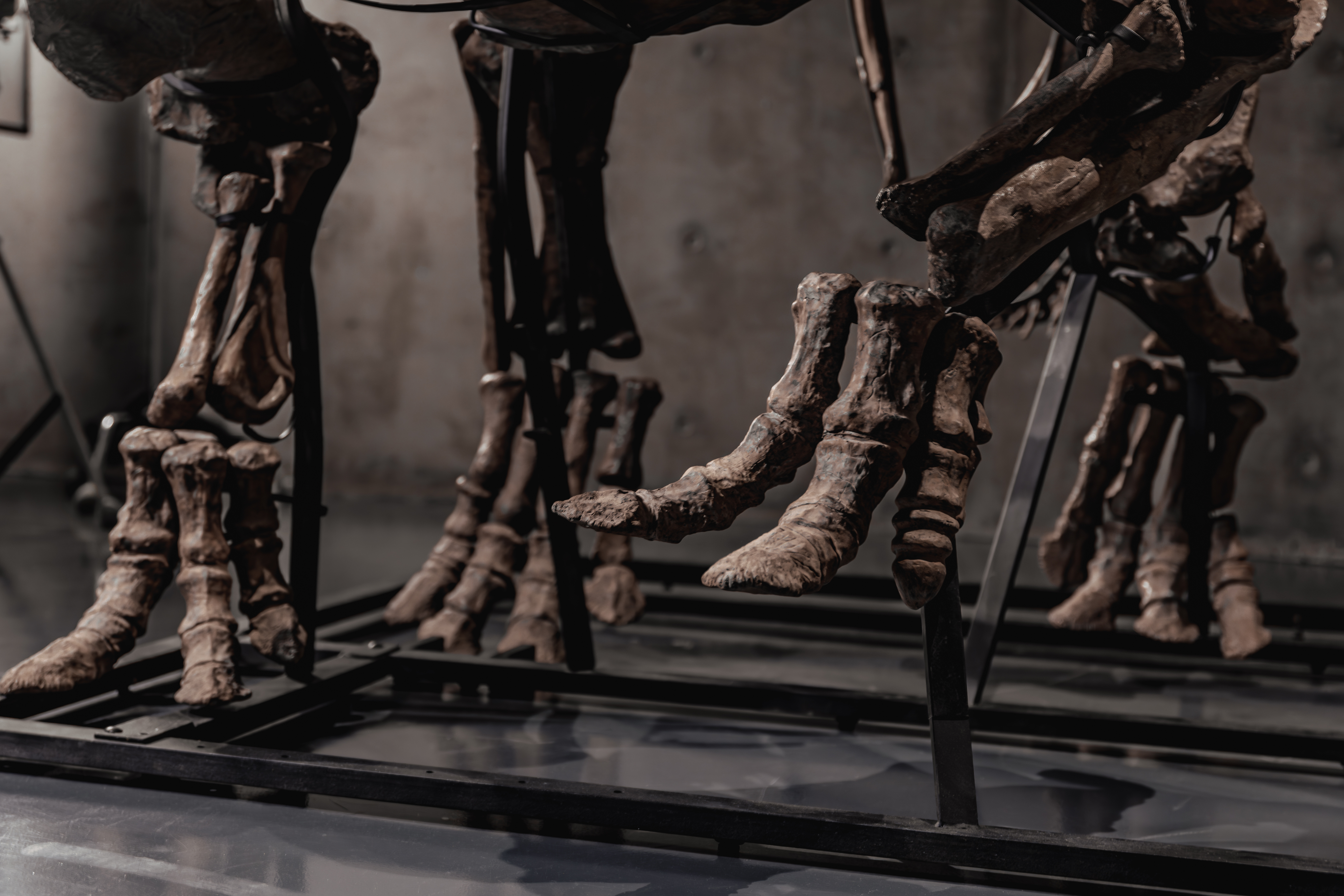
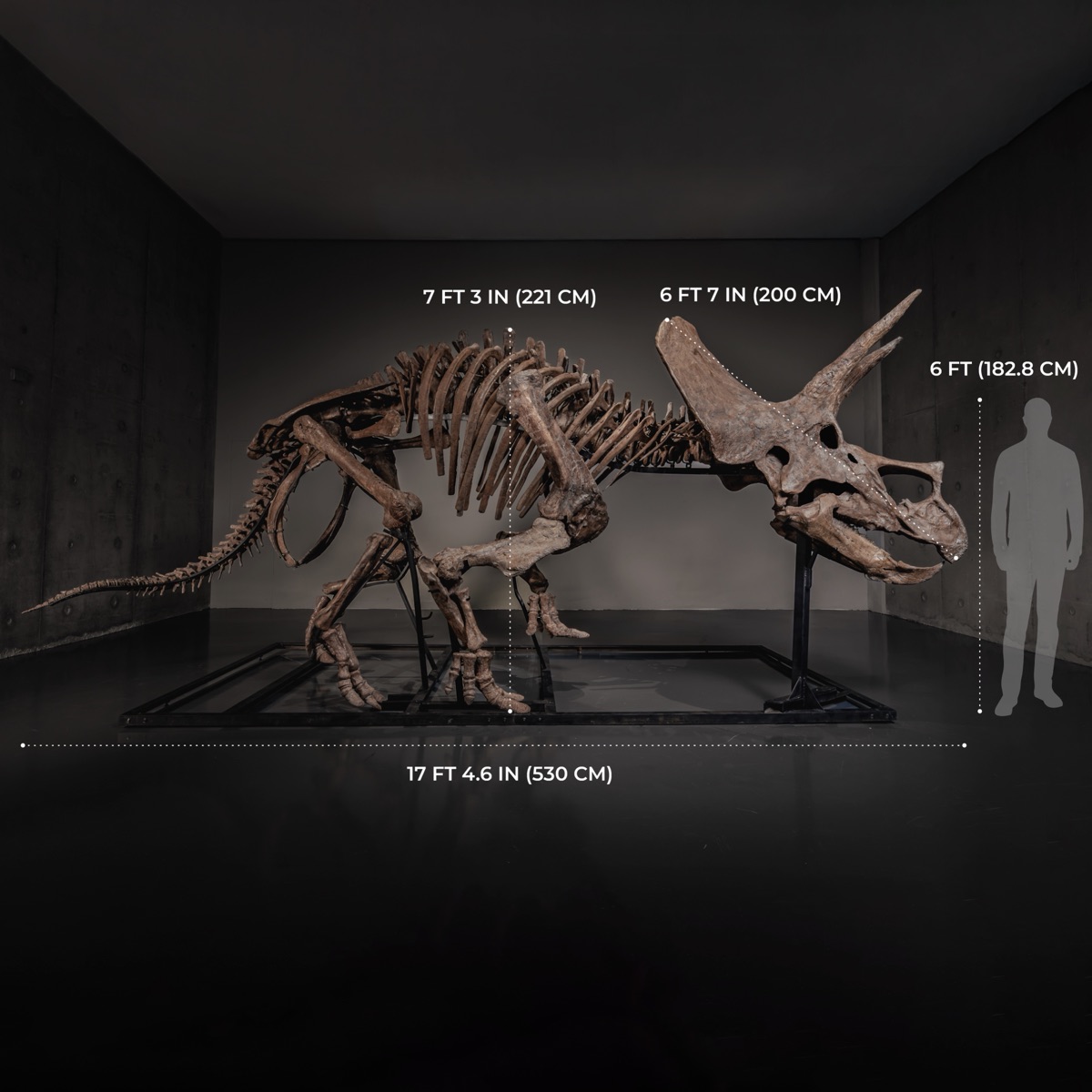
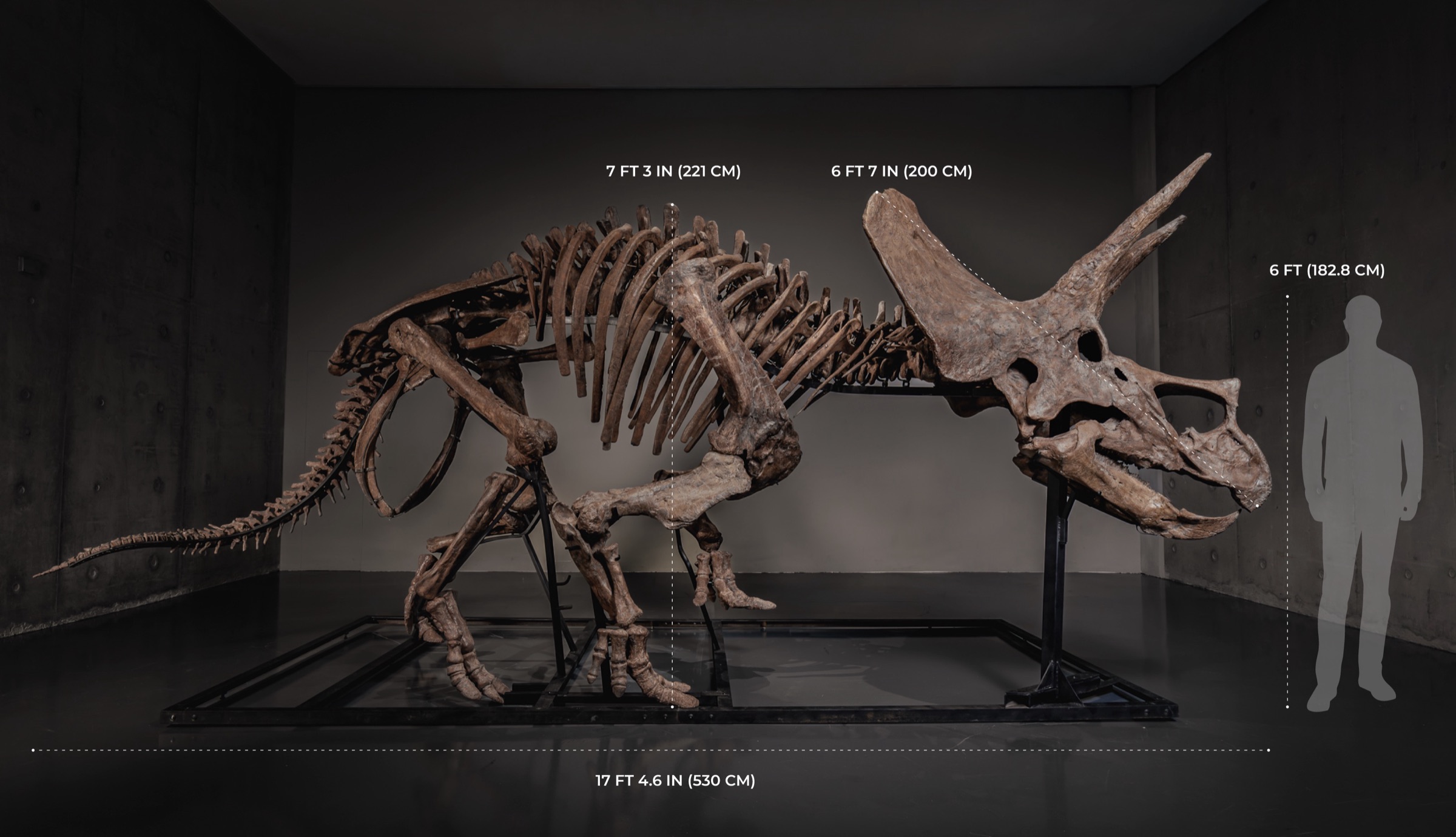
Fully grown, Triceratops could reach 9 meters in length and weigh as much as two elephants—an animal built like a battering ram in armour. Trey captures that power in a sub-adult scale—still monumental, but with a presence that is strikingly displayable. At 5.3 meters from nose to tail, he stretches the length of a NYC yellow cab; at over 2.2 meters tall, he stands just below a basketball hoop.
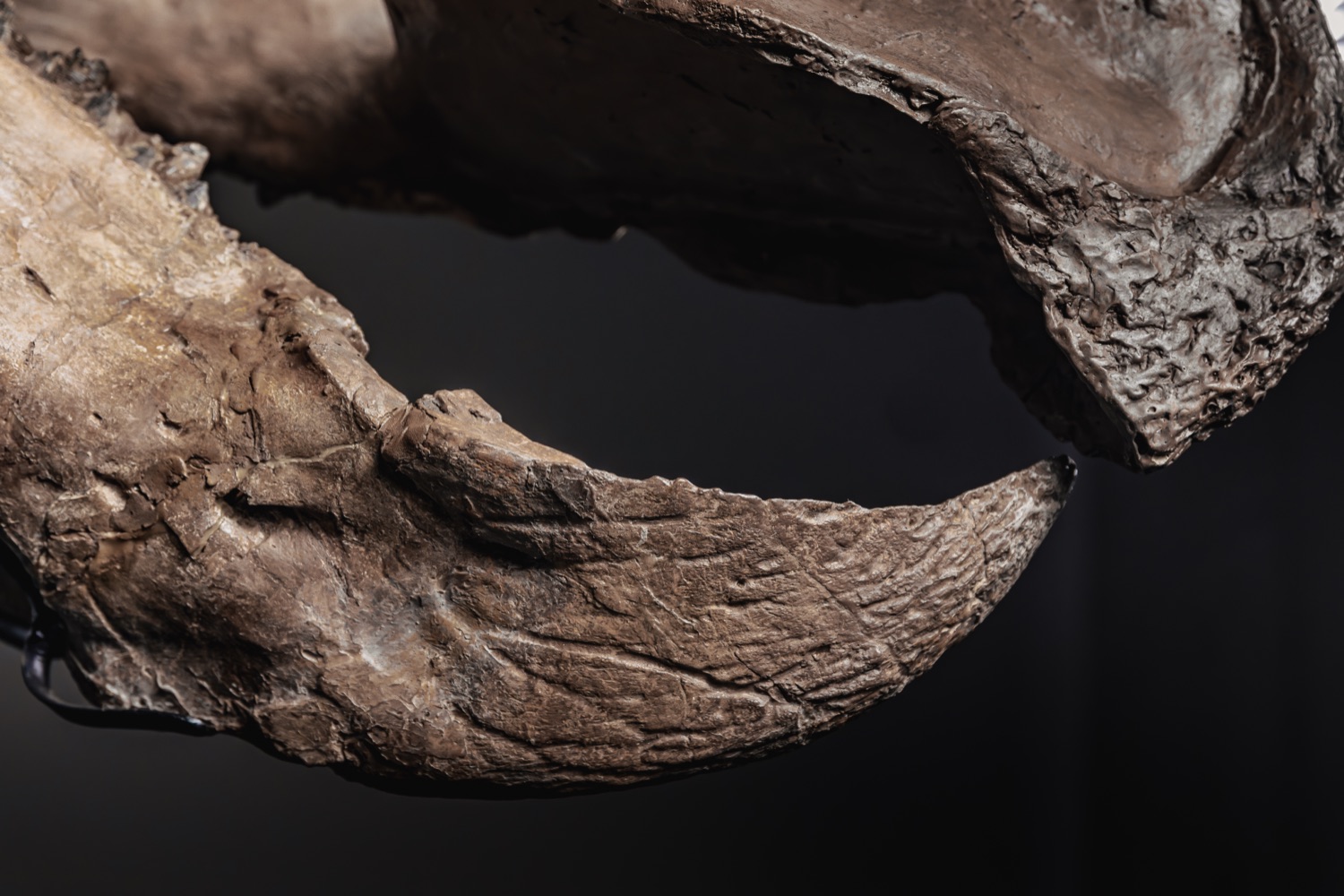
The skull is the showstopper: two meters from beak to frill—parrot-beaked at the snout, fanning into a great shield of bone—crowned by a brow horn that rises nearly as high as an upright guitar. Trey is a chasmosaurine—one branch of the ceratopsians, the "horned-face" dinosaurs—defined by sweeping frills, massive brow horns, and a skull built for intimidation and survival.
Unearthed in the American West
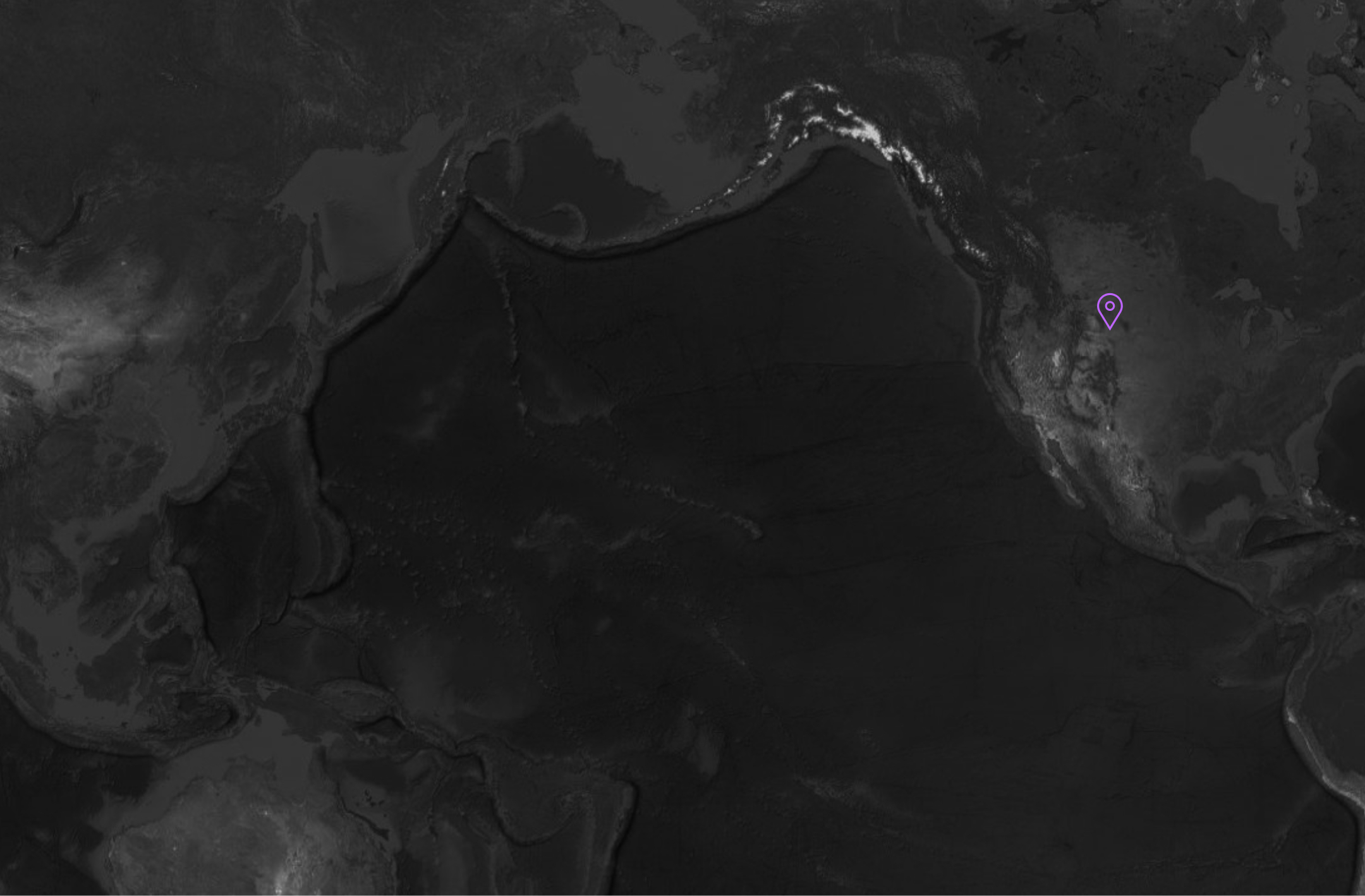
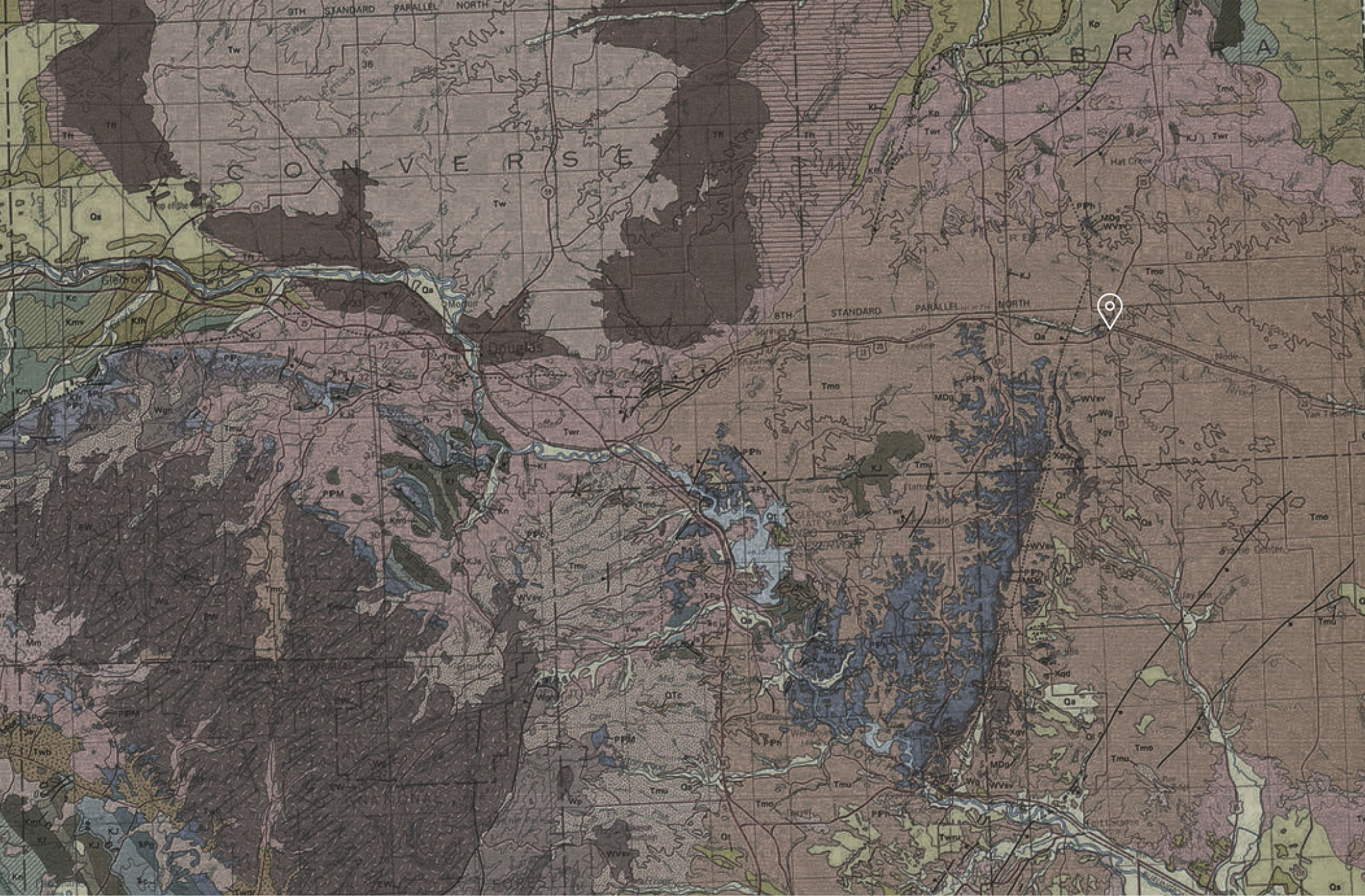
In 1993, in the heat of the modern "Bone Rush," Trey emerged from the Lance Formation, a Late Cretaceous rock unit, near Lusk, Wyoming—bones sealed for millions of years, then suddenly back in the light. This was the open-country pursuit of deep time: leases, field camps, long days in dust and wind, and the patient discipline required to seek history in stone. The discovery brought together Lee Campbell and Allen Graffham of Geological Enterprises, Inc., one of the defining figures in modern commercial paleontology.

Pictured here from left to right, Allen Graffham, Lee Campbell and Fran Graffham opening the Triceratops quarry in Lusk, Wyoming.

(Left to right) Lee Campbell, Fran Graffham and Allen Graffham at the Triceratops quarry in Lusk, Wyoming.
Often compared to the legendary Charles H. Sternberg for his impact on museum collections worldwide, Graffham is credited with discovering more than 50 new species, several new genera, and even an entirely new family of invertebrate fossils in the United States—contributions of a scale rarely seen in the 21st century. In an era when the fossil record can feel fully charted, Graffham's work stands as proof that discovery still belongs to those willing to go out and find it.
Trey is the only dinosaur specimen procured through Graffham to return to market in the past two decades—and the final privately held specimen from his discoveries.
The badlands of Wyoming.
Three Decades in the Public Eye
Many dinosaurs are known to science. Trey is known to people.


Following excavation, Trey was transported to Germany in 1993 for meticulous preparation and mounting before returning to the United States. In 1995, he became the centerpiece of the Wyoming Dinosaur Center in Thermopolis, where he remained on continuous public display for nearly thirty years. In Wyoming—where Triceratops is honored as the state dinosaur—Trey became a defining public emblem of prehistory.
Across three decades, generations of visitors encountered Trey—children meeting the Cretaceous face-to-face for the first time, families standing beneath the sweep of his frill, scholars studying articulation and preservation. Few dinosaur skeletons experience such sustained public presence. Fewer still return to market after it.
A Scientific Touchstone
A Sub-Adult Triceratops For Chasmosaurine Comparison
Examined and contextualized by paleontology expert Andre LuJan, Trey is more than an impressive mount: he is a research-grade Triceratops. Preserved as a sub-adult, he captures the animal in transition—an underrepresented stage that can sharpen how scientists track growth and anatomical change in chasmosaurines. Dr. Frederic Lacombat noted that the epoccipital bones along the frill are not yet present or fused, consistent with Trey's younger age. As a Lance Formation specimen from the closing phase of the Cretaceous, Trey sits in one of the most intensively studied dinosaur ecosystems in North America, and his skull and axial skeleton provide clear comparative points for anatomy and development.
His preservation is strongest where it matters most: in the major, diagnostic skeletal elements that define anatomy, articulation, and form. And then there is what time itself has done. Over millions of years, groundwater and iron-rich minerals slowly replaced bone, painting the skeleton in warm earth tones—natural art laid down on a once-living canvas. What remains is not simply structure, but surface: a visual record of deep time.


Opportunities to acquire a dinosaur of this caliber are exceptionally rare.
Most major specimens remain permanently in institutional collections and never re-enter the market.
With his singular provenance and unprecedented public life, Trey presents a unique opportunity for collectors and institutions to assume stewardship of a scientifically documented, culturally resonant, and historically significant specimen.

The Lost World directed by Harry O. Hoyt, 1925.
A Cultural Presence
Triceratops is the face of prehistory—so iconic it has become a universal shorthand for the Age of Dinosaurs. From nineteenth-century scientific diagrams to museum halls and cinema screens—from The Land Before Time to the unforgettable Jurassic Park encounter—it has endured as the definitive herbivore: power, presence, and survival, set against Tyrannosaurus rex in the most enduring drama of primeval world.
Trey carries that cultural memory in a uniquely literal way. After decades on continuous public display, he helped shape how a generation pictured the prehistorical: people didn't just read about Triceratops or watch it on screen—they met one.


Commemorative Capsule
In honor of TREY, JOOPITER and cultural institution Co-Museum partnered with Los Angeles brand 424 on a limited capsule.
Shop the Capsule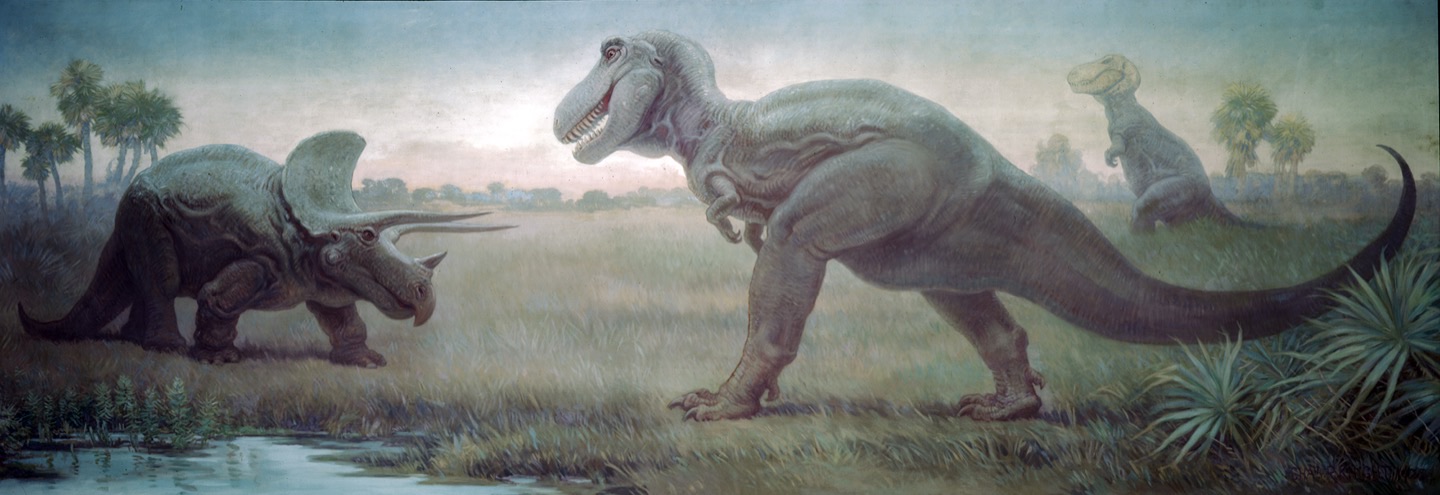
For The Next Generation
A teenaged dinosaur, miraculously preserved from the final, volatile years of the Late Cretaceous—a world of sudden floods, fire, and constant geological change.
His world ended in extinction. Trey endured: fossilized, discovered, exhibited. Now, his story continues.
This sale supports Co-Museum, a cultural platform that brings community into dialogue with objects through storytelling-led drops and shared ownership. It also advances the education, preservation, and expanding public access to the world's most significant cultural assets through immersive experiences and community-powered models.
Together, these efforts reflect a shared conviction: natural history is not static, and it should not be exclusive. Preserved across 66 million years and shaped by decades in the public eye, Trey stands at the threshold of a new era of stewardship.
Charles R. Knight mural at the Field Museum of Natural History in Chicago, 1928.
“”
Trey is a rare collision of science and human memory—an extraordinary Triceratops preserved at a pivotal stage of growth, and shaped by decades in the public eye. More than a million people have stood before him. He is a teenaged ambassador from deep time—proof that research can become something the public feels, and carries with them.
Andre Lujan
Paleontology Expert